Denmark does not shout for attention in the global property arena. It rarely produces the dramatic price surges of southern Europe or the cyclical volatility seen in larger Anglo-Saxon markets. Instead, it offers something both less exciting and, for many investors, far more valuable: consistency. In 2026, that quality has come back into sharper focus.
After the turbulence that swept across European real estate between 2022 and 2024—fuelled by inflation, aggressive monetary tightening and a recalibration of asset values—Denmark’s housing market has emerged in relatively robust condition. Prices corrected, but not severely. Demand cooled, but did not collapse. Financing tightened, yet remained accessible within a disciplined framework.
For international buyers, Denmark presents a distinctive proposition. It is not a low-cost market, nor is it an easy one to enter without preparation. Yet its transparency, economic resilience and high quality of life continue to underpin long-term demand. Property for sale in Denmark in 2026 is less about opportunism and more about strategic positioning.
A Market Tempered by Monetary Discipline
The Danish housing market, like much of Europe, felt the force of rising interest rates in the wake of post-pandemic inflation. Denmark’s central bank, closely aligned with the European Central Bank due to the krone’s peg to the euro, followed the broader tightening cycle.
Mortgage rates, which had hovered at historically low levels for years, rose sharply through 2022 and into 2023. Fixed-rate loans moved from near 1% to above 5% in some cases. The impact was immediate. Transaction volumes fell, buyer confidence weakened, and price growth stalled.
Yet Denmark’s long-established mortgage system—often regarded as one of the most stable in the world—played a crucial role in preventing systemic stress. The widespread use of fixed-rate loans and conservative lending standards meant that households were less exposed to sudden payment shocks than in more volatile markets.
By late 2025 and into 2026, conditions began to stabilise. Inflation eased back towards 2–3%, and borrowing costs moderated slightly, with mortgage rates generally settling in the 3.5% to 4.5% range. This has allowed activity to resume, albeit at a measured pace.
Prices, after a modest decline of around 5–10% in certain segments during the correction, are once again edging upwards, particularly in urban centres where supply remains constrained.
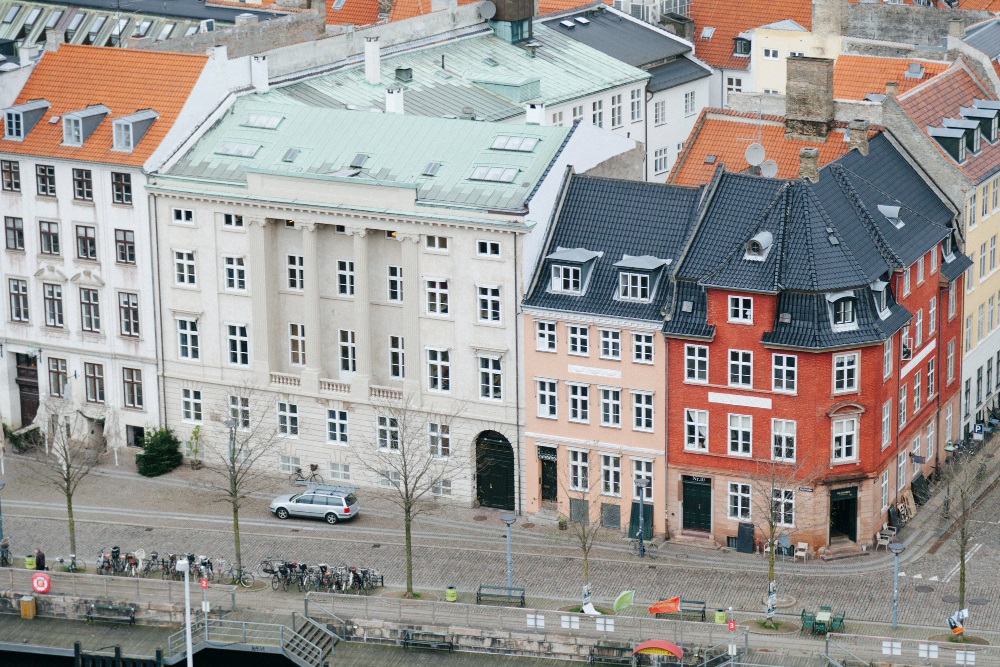
Copenhagen: A Capital Defined by Scarcity
Copenhagen sits at the centre of Denmark’s property landscape, both geographically and economically. It is a city shaped by water, design and careful planning, and these same characteristics impose strict limits on housing supply.
In 2026, average apartment prices in Copenhagen typically range between €6,000 and €9,000 per square metre, with prime central districts exceeding €10,000. These figures place the Danish capital firmly within the upper tier of European property markets.
Affordability is an ongoing concern. While Denmark enjoys relatively high average incomes, the gap between wages and property prices has widened over the past decade. This has moderated domestic demand at the upper end, but it has also reinforced the strength of the rental sector.
Rental yields in Copenhagen are generally modest, often between 2.5% and 4%. This reflects high acquisition costs and a regulated rental environment. However, the city’s enduring appeal—driven by its strong economy, world-class infrastructure and international reputation—provides a degree of long-term security.
Investors are not drawn to Copenhagen for rapid gains. They come for stability, liquidity and the assurance that demand is unlikely to evaporate.
Beyond the Capital: Aarhus, Odense and Regional Dynamics
While Copenhagen dominates, Denmark’s regional cities offer a more varied and, in some cases, more accessible entry point.
Aarhus, the country’s second-largest city, has developed into a vibrant centre for education, culture and business. Property prices here are lower than in Copenhagen, typically ranging from €4,000 to €6,500 per square metre. The presence of a large student population and a growing professional workforce supports a healthy rental market, with yields often slightly higher than in the capital.
Odense, undergoing significant redevelopment in recent years, presents another layer of opportunity. Prices are more modest, generally between €3,000 and €5,000 per square metre, reflecting both its smaller size and ongoing transformation.
Further afield, smaller towns and rural areas offer considerably lower prices, sometimes below €2,500 per square metre. However, these markets are more sensitive to demographic trends, including population decline in certain regions. Investors must therefore approach them with a clear understanding of local demand.
The Danish market is not homogeneous. It rewards selectivity and an appreciation of regional nuance.
Foreign Ownership: Opportunity with Conditions
Denmark is often perceived as an open and transparent market, and in many respects it is. However, property ownership by non-residents is subject to certain restrictions.
Foreign buyers who are not residents of Denmark typically require permission from the Ministry of Justice to purchase property. This is particularly relevant for second homes and holiday properties. Permanent residence or a demonstrable connection to the country can ease the process, but it is not automatic.
For EU citizens residing in Denmark, the process is more straightforward. Non-EU buyers may face additional scrutiny.
These restrictions do not eliminate foreign investment, but they do shape it. International buyers tend to focus on long-term residency, relocation or corporate structures rather than purely speculative acquisitions.
For those willing to navigate the administrative requirements, Denmark remains accessible. However, it is not a market for casual entry.
The Rental Sector: Regulation and Resilience
Denmark’s rental market is characterised by a high degree of regulation, reflecting the country’s broader commitment to social balance and housing accessibility.
Rent controls apply in many areas, particularly for older properties. These regulations can limit rental increases and, in some cases, cap returns. Newer properties are subject to fewer restrictions, making them more attractive to investors seeking flexibility.
Despite these constraints, demand for rental housing remains strong. High property prices, coupled with demographic trends such as urbanisation and a growing expatriate workforce, have sustained occupancy levels.
In Copenhagen, average rents in 2026 typically range between €18 and €25 per square metre per month for well-located apartments. Aarhus and other cities offer slightly lower figures, though still robust by European standards.
Institutional investors, including pension funds, play a significant role in the Danish rental market. Their presence contributes to stability but also intensifies competition for prime assets.
Financing and Mortgage Structure
Denmark’s mortgage system is frequently cited as one of the most sophisticated and resilient globally. It is based on a system of mortgage bonds, which align closely with individual loans and provide a high degree of transparency.
In practical terms, this translates into:
Borrowing limits typically up to 80% of property value for owner-occupied homes
Lower limits for investment properties
A wide choice between fixed-rate and adjustable-rate mortgages
The ability to refinance efficiently as market conditions change
In 2026, mortgage rates have moderated from their recent peak but remain above the ultra-low levels of the previous decade. Borrowers are increasingly opting for fixed-rate products, reflecting a preference for certainty.
For foreign buyers, access to Danish mortgage financing may be more limited, particularly without local income or residency. As a result, many rely on equity or financing from their home country.
The system’s conservatism is both a strength and a constraint. It reduces systemic risk, but it also limits rapid expansion.
Transaction Costs and Taxation
Denmark is not a low-cost market in terms of transaction expenses, and these must be factored into any investment decision.
Typical costs include:
A property registration fee of approximately 0.6% of the purchase price plus a fixed administrative charge
Legal fees, often ranging from 1% to 2%
Estate agency fees, typically paid by the seller but indirectly reflected in pricing
Annual property taxes are relatively high compared to some European markets, though recent reforms have aimed to modernise and rebalance the system. These taxes are based on property value and location, and they can have a meaningful impact on holding costs.
Capital gains tax may apply, particularly for investment properties, though exemptions exist for primary residences under certain conditions.
Transparency in taxation is a hallmark of the Danish system, but it requires careful navigation.
Economic Context: A Foundation of Stability
Denmark’s broader economic environment remains one of its greatest strengths.
The country consistently ranks among the most competitive and least corrupt economies globally. Its labour market is flexible, its workforce highly skilled, and its public finances well managed.
GDP growth in 2026 is expected to be steady, in the region of 1.5% to 2.5%, reflecting a mature economy rather than a rapidly expanding one. Inflation has been brought under control, and unemployment remains low.
Key sectors such as pharmaceuticals, renewable energy and shipping continue to perform strongly. Denmark’s leadership in green technology, in particular, is attracting international investment and supporting long-term economic prospects.
These fundamentals provide a stable backdrop for the property market. They do not guarantee rapid growth, but they do reduce the likelihood of severe downturns.
Supply Constraints and Urban Planning
One of the defining features of the Danish property market is the constraint on supply, particularly in major cities.
Urban planning in Denmark is deliberate and controlled. Development is carefully managed, with an emphasis on sustainability, liveability and architectural integrity. While this enhances the quality of the built environment, it also limits the pace at which new housing can be delivered.
In Copenhagen, this constraint is particularly pronounced. Geographic limitations, combined with strict planning regulations, mean that new developments are often complex and time-consuming.
The result is a structural imbalance between supply and demand. Even during periods of economic uncertainty, this imbalance helps to support property values.
For investors, it reinforces the importance of location. Well-positioned assets in supply-constrained areas tend to retain their value more effectively.
Risks and Considerations
Despite its stability, the Danish property market is not without risk.
Interest rates, while lower than their recent peak, remain a key variable. Any renewed inflationary pressure could lead to further tightening, with implications for both affordability and demand.
Regulation, particularly in the rental sector, can limit flexibility and returns. Investors must understand the legal framework in detail.
The high cost of entry is another factor. Denmark is not a market for bargain hunting. Capital requirements are significant, and yields are relatively modest.
Currency considerations may also play a role for international buyers, although the Danish krone’s peg to the euro provides a degree of stability.
Finally, demographic trends in certain regions, including population ageing and migration towards larger cities, can affect long-term demand.
Outlook: Measured Growth in a Mature Market
Looking ahead, the Danish property market in 2026 and beyond is likely to follow a path of gradual, measured growth.
The era of ultra-low interest rates and rapid price appreciation has passed. In its place is a more balanced environment, characterised by steady demand, constrained supply and disciplined financing.
Copenhagen will remain the focal point for both domestic and international investors, supported by its economic strength and global reputation. Regional cities such as Aarhus and Odense will continue to offer alternative opportunities, particularly for those seeking slightly higher yields.
For international buyers, Denmark represents a particular kind of investment. It is not about chasing high returns or short-term gains. It is about placing capital in a market that prioritises stability, transparency and long-term value.
Conclusion: A Market Defined by Confidence, Not Hype
Property for sale in Denmark in 2026 reflects a broader truth about the country itself. It is measured rather than exuberant, structured rather than speculative, and quietly confident in its foundations.
In a European landscape still adjusting to economic change, that confidence carries weight. Investors may not find dramatic bargains or rapid appreciation, but they will find a market that behaves predictably, governed by clear rules and supported by strong institutions.
For those prepared to accept its constraints, Denmark offers something increasingly rare in global real estate: a sense of calm.
Financial Disclaimer: The information provided in this article is for general informational purposes only and does not constitute financial advice. While every effort has been made to ensure the accuracy of the content, market conditions may change, and unforeseen risks may arise. The author and publisher of this article do not accept liability for any losses or damages arising directly or indirectly from the use of the information contained herein.
Copyright: schengenproperty.com
Pictures by: www.magnific.com/